KingdomFungiGenusCantharellusSpeciescibarius
Cantharellus cibarius
T0 · No known toxinsPublished 2026-08-06Summer / Autumn
The chanterelle is the species most often used as a reference point for everything else in a basket, and it earns that role: the blunt forked folds, the apricot colour that survives drying, and the absence of any ring, volva or stain make it one of the few large fruit bodies in temperate woodland that can be resolved with a hand lens alone. It still carries three genuine look-alikes, and all three resolve on characters you can see in the field.
Block 01 · Record
Field characters worth photographing before you pick
Photograph the underside first. A mature chanterelle cap curls and the folds fold in on themselves, so a dropped specimen may present nothing but a yellow convex blob. Record four things at the site: the depth of the folds, whether they fork, how far they run down the stem, and whether the edge is blunt or sharp. Blunt is the chanterelle. Take a second photograph of the stem base in situ, because the tapering white mycelial point is destroyed by pulling.
Microscopy and the reagent bench
The spore print is pale cream and needs a full night on white paper — a print taken over four hours will read as white and send you down the wrong branch of any key. Spores are 8-11 x 4.5-6 micrometres, smooth, with one large oil drop in perhaps a third of them. Melzer's reagent leaves the wall pale yellow, which is the point: an amyloid or dextrinoid reaction here rules the specimen out entirely. Cotton blue leaves the spores unstained, so they appear as clear halos against the blue mount. Iron(II) sulfate on the flesh is negative over 60 seconds.
Habitat and season
The species is a strict ectomycorrhizal associate and does not fruit from a substrate you can identify by eye — you have to identify the standing trees instead. Oak, beech and sweet chestnut on acidic loam are the reliable combinations across western Europe; in the Pacific Northwest the same niche is filled by the wider C. cibarius complex, which molecular work has split into several species that are not separable in the field. Fruit bodies appear from mid-July through October, peaking in the two weeks after a sustained rain that follows a dry spell.
Discrimination and look-alikes
Omphalotus illudens is the pair that matters. It grows in dense overlapping clusters from buried wood, and its gills are true thin blades with sharp edges that never fork. If you are uncertain, take a fresh fruit body into a completely dark room and let your eyes adapt for four minutes — jack-o'-lantern gills produce a faint green luminescence, and chanterelle gills do not. Hygrophoropsis aurantiaca is a smaller, thinner mushroom on conifer litter whose gills fork repeatedly and are crowded rather than widely spaced.
Points to carry to the bench
- Folds fork once or twice and are blunt at the edge — a sharp-edged blade means it is not a chanterelle.
- Spore print needs a full overnight deposit; a short print reads white and miskeys the specimen.
- Inamyloid spores and no colour change in iron(II) sulfate are the two bench confirmations.
- Any brown or blue bruise reaction disqualifies the specimen.
| Cap | shape: Convex then plano-convex, 30-90 mm across, rarely exceeding 110 mm; margin irregular, wavy and lobed from the earliest stage.surface: Egg-yolk yellow to pale apricot, dry, matte, smooth when young and faintly tomentose at the centre when old; never viscid.margin: Thin, inrolled when young, spreading and undulate at maturity; concolorous with the cap, never striate. |
|---|---|
| Gills | attachment: Not gills but folds — blunt, 1-3 mm deep ridges that are decurrent for 5-15 mm down the stem and fork once or twice between margin and stem.spacing: Widely spaced, 8-14 folds reaching the margin on a 60 mm cap, with flat, rounded interspaces as wide as the folds themselves.edge: Entire and blunt; the edge is never sharp enough to cut paper, which is the single most useful field character. |
| Spore print | Ellipsoid to broadly ellipsoid in profile, smooth-walled, with a short oblique hilar appendix.Smooth, inamyloid; a few spores carry a single large oil drop. |
| Habitat and season | Ectomycorrhizal in broadleaf and mixed woodland, most consistently under oak, beech and sweet chestnut on acidic to neutral loam. Fruit bodies appear on bare soil or in thin leaf litter, frequently at the edge of a track or in a shallow ditch where the litter layer stays damp. |
Block 02 · Chemistry
| Reagent | Verdict | Reaction | Weight |
|---|---|---|---|
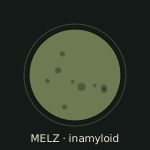 MELZ | inamyloid | Spore wall stays pale yellow; no blue or red-brown development over 5 minutes. | 3.00 |
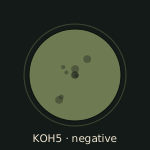 KOH5 | negative | Cap cuticle dulls to greyish-brown but develops no yellow, green or vinaceous tone. | 2.00 |
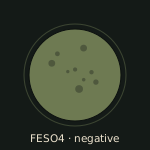 FESO4 | negative | Flesh shows no colour change after 60 s; a faint grey wash on the cuticle is within normal variation. | 3.00 |
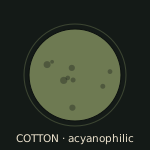 COTTON | acyanophilic | Spores remain unstained against a blue background; the outline reads as a clear halo. | 2.00 |
Injury stain None. Bruised folds and cap flesh keep the same apricot-yellow tone for at least an hour; any brown or blue reaction at a bruise indicates the specimen is not this species.
Block 03 · Confusion
| Separating character | This record | Confused with |
|---|---|---|
| True sharp gills that do not fork, growth in dense clusters on buried wood rather than on soil, and a faint green glow from fresh gills in complete darkness. | Cantharellus cibariusT0 | Omphalotus illudens▲ +1 |
| Thin, repeatedly forked true gills that are decurrent and crowded, a floccose orange cap, and growth on conifer litter instead of soil. | Cantharellus cibariusT0 | Hygrophoropsis aurantiaca▲ +1 |
| Brown cap, hollow grey-yellow stem, and folds that run the full length of the stem; the two species rarely share a substrate. | Cantharellus cibariusT0 | Craterellus tubaeformis▲ +0 |
Toxicity ladder
No toxin has been isolated or reproduced in feeding trials, and decades of documented ingestion carry no reproducible syndrome. T0 is a statement about the chemistry of the species, never a statement about a specimen in your hand.
Lamella · https://honeydew.top