KingdomFungiGenusEntolomaSpeciessinuatum
Entoloma sinuatum
T2 · Organ toxicPublished 2026-10-16Late summer / Autumn
The livid pinkgill is a large, white, fleshy mushroom that grows in grass at the edge of woods, smells of meal, and has poisoned people for as long as people have been writing about mushrooms. Its syndrome is severe and occasionally life-threatening, and the only character that separates it from two harmless species is the shape of its spores.
Block 01 · Record
The deep notch and the pink gills
Two field characters are worth learning. The first is the gill attachment: the gills run toward the stem, dip sharply upward into a deep notch, then resume on the other side — a shape that is visible at arm's length on a mature specimen and that is not present in Clitopilus prunulus, whose gills run straight down the stem. The second is the colour sequence: white gills for most of the fruit body's life, then salmon-pink starting at the stem and spreading outward as the spores mature. Both characters are useful; neither excludes Calocybe gambosa, which shares the white gills and the mealy smell.
The angular spore
Leave a cap gill-down on white paper overnight and the deposit is salmon-pink. Spores are 8-11 x 7-9 micrometres and isodiametric, and they bear five to seven flat facets meeting at corners — an angular, almost polygonal outline with no longitudinal ribs of any kind. The facets are visible in a plain water mount at 1000x with no stain. Clitopilus prunulus, the most dangerous confusion, has spores with six to eight longitudinal ribs running pole to pole and no facets at all. Facets or ribs: there is no third option, and the distinction survives drying.
Habitat and the edge-of-wood problem
Entoloma sinuatum is ectomycorrhizal with broadleaves on neutral to calcareous soils and it fruits in exactly the habitat where the harmless species it resembles also fruit: soil in grass at wood margins, open woodland, rides, and under isolated oaks. Fruit bodies are large — the cap reaches 200 mm — and appear in troops from late August through October. The size is part of the problem: a 150 mm white mushroom looks like something worth carrying home, and it is often found alongside smaller, genuinely harmless white species at the same edge.
The syndrome and the tier
The species produces a violent gastrointestinal syndrome with a latency of thirty minutes to three hours: repeated vomiting, profuse diarrhoea, abdominal pain and, in severe cases, dehydration requiring intravenous fluids. Historically it was regarded as one of the most dangerous species in Europe and it was known simply as Entoloma lividum — 'the livid one' — because its effects were so much worse than its appearance suggested. The tier is T2 because severe cases have required hospital admission and the literature contains fatalities, even though no specific organ toxin has been characterised.
Points to carry to the bench
- Gills dip into a deep upward notch where they meet the stem; Clitopilus prunulus has straight decurrent gills.
- Spores are five- to seven-sided facets, not ribbed — the only reliable separation from the T0 miller.
- Salmon-pink overnight spore print; white flesh and a farinaceous smell shared with harmless species.
- Large white agaric in grass at wood margins from late August; T2 with documented hospital admissions.
| Cap | shape: Convex to plano-convex, becoming plane with an irregular wavy margin, 60-200 mm across; the margin is long-inrolled and often remains downcurved.surface: Ivory-white to pale grey, silky and smooth, sometimes with a faint grey-brown tinge at the centre; dry, never viscid, and not scaly.margin: Inrolled then wavy and irregularly lobed; not striate, even on wet specimens. |
|---|---|
| Gills | attachment: Sinuate to emarginate — the gills approach the stem, dip sharply up into a notch, then resume; this deep notch is visible at arm's length on a mature specimen.spacing: Close, 3-4 gills per millimetre, with three or four series of intermediates.edge: Entire and concolorous; the gills are white when young and turn salmon-pink from the stem outward as the spores mature. |
| Spore print | Isodiametric and angular — five to seven flat facets meeting at corners, with no longitudinal ribs of any kind.Smooth-walled, thick-walled, with a distinct hilar appendix; the facets are visible in a water mount at 1000x without staining. |
| Habitat and season | Ectomycorrhizal with broadleaves on neutral to calcareous soils, fruiting on soil in grass at wood margins, in open woodland, along rides and under isolated oaks; strongly favours the same edge habitat as the harmless species it resembles. |
Block 02 · Chemistry
| Reagent | Verdict | Reaction | Weight |
|---|---|---|---|
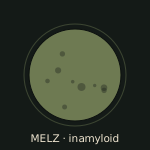 MELZ | inamyloid | Spore wall stays pinkish; no blue-black development, and the facets do not darken. | 3.00 |
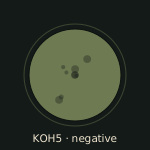 KOH5 | negative | Cap surface darkens slightly to grey-brown; no yellow, green or red development. | 2.00 |
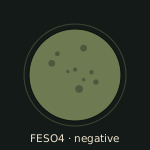 FESO4 | negative | Flesh unchanged after 60 s; no salmon-pink. | 3.00 |
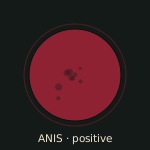 ANIS | positive | Grey-violet spreading from the cuticle into the flesh at the disc, reading near-black at five minutes. | 2.00 |
 COTTON | acyanophilic | Spores remain unstained and the angular outline reads clearly against the blue background. | 2.00 |
Injury stain None. The thick white flesh keeps its colour when cut and does not yellow, redden or brown. The only visible change on handling is a slight dulling of the silky cap surface.
Block 03 · Confusion
| Separating character | This record | Confused with |
|---|---|---|
| Spores with six to eight longitudinal ribs rather than flat facets, deeply decurrent gills rather than sinuate, and a smaller cap with a lobed, irregular margin. The field characters overlap completely. | Entoloma sinuatumT2 | Clitopilus prunulus▲ +2 |
| A spring species — April to June, not August to October — with a white spore print and a strong mealy odour. The season alone separates it, which is why the two are rarely in a basket together. | Entoloma sinuatumT2 | Calocybe gambosa▲ +2 |
| A slimmer woodland species with a hygrophanous grey-brown cap and the same angular spores, growing in leaf litter rather than in grass; it is T1 rather than T2. | Entoloma sinuatumT2 | Entoloma rhodopolium▲ +1 |
Toxicity ladder
The toxin reaches an organ and damages it. Latency is the defining hazard: Cortinarius orellanus and Amanita smithiana produce no symptoms for 3 to 20 days, by which time renal function is already falling. T2 also covers syndromes that require a co-factor, such as coprine and ethanol, or a susceptible host, such as Pleurocybella porrigens in dialysis patients.
Lamella · https://honeydew.top