KingdomFungiGenusGalerinaSpeciesmarginata
Galerina marginata
T3 · LethalPublished 2026-08-22Autumn / Spring
This is the species that makes wood-inhabiting brown-spored agarics a category to treat carefully rather than a category to collect. It produces the same amatoxins as the death cap, at concentrations that have killed, and it is separated from a genuinely harmless species by a ring that is usually missing by the time you find the mushroom.
Block 01 · Record
The ring problem
Every popular description says the same thing: Galerina marginata has a membranous ring on the upper stem. What the descriptions understate is that the ring is fragile and tears away early. On a fully expanded fruit body you will often find no ring at all, or a scrap of white membrane adhering to the stem three millimetres below the cap. The persistent ring of Kuehneromyces mutabilis survives to maturity, so absence of the ring is evidence in favour of Galerina rather than against it. This inversion — where a missing character is the diagnostic one — is why the pair is dangerous.
Spores, ornamentation and the plage
The spore deposit is rusty brown with a warm orange cast, and it needs a night on white paper. Spores are 8-10.5 x 5-6 micrometres, amygdaliform, with a flattened ventral side. Their ornamentation is fine, warty to rugulose, and is interrupted by a smooth plage immediately above the hilar appendix. In Melzer's reagent the spore wall does not turn blue-black, but the ornamentation is thrown into sharp relief and the plage becomes unmistakable. In cotton blue the warts stain and the plage stays clear, which is the reading to use when the Melzer's result is ambiguous.
Substrate, habit and season
The species fruits from dead wood, overwhelmingly conifer wood: stumps, sawn logs, fallen branches, and buried wood that shows at the surface as a crack in the soil. It grows in loose clusters that are easy to mistake for scattered individuals, unlike the dense caespitose tufts of K. mutabilis. In temperate Europe the main flush runs from September to November; in colder and montane regions there is a second, smaller flush in April and May. The white mycelial felt at the stem base extends into the wood and is the surest way to confirm the substrate.
Toxicology of the amatoxin dose
The amatoxin content of Galerina marginata is comparable to that of Amanita phalloides per gram of fresh tissue, and the clinical course is the same: a gastrointestinal phase at 6-24 hours that appears to resolve, a silent interval, and then hepatic failure at 3-5 days. Cooking does not destroy amatoxins. Handling fruit bodies for a spore print carries no risk; the risk is entirely in ingestion, and a single misidentified cluster on a log is enough. Kuehneromyces mutabilis on the same log is the reason to take every collection on wood-clustered brown-spored agarics to a spore print before it goes anywhere near a kitchen.
Points to carry to the bench
- A missing ring is evidence for Galerina, not against it; Kuehneromyces keeps a firm persistent ring.
- Rusty brown spore deposit with a warm orange cast, never chocolate or purple.
- Spores amygdaliform with warty ornamentation and a smooth plage above the hilar appendix.
- Fruits on conifer wood in loose clusters; amatoxin content comparable to Amanita phalloides.
| Cap | shape: Convex then plano-convex to flat, 15-45 mm across, occasionally with a low umbo; the margin is inrolled when young.surface: Strongly hygrophanous: honey-yellow to ochre-brown when wet, drying out from the centre to a pale buff, with a clearly two-toned appearance during the transition.margin: Translucently striate almost to the centre when moist, the striations vanishing within minutes of picking. |
|---|---|
| Gills | attachment: Adnexed to narrowly adnate, meeting the stem with a small notch; not decurrent.spacing: Close, 25-35 gills reaching the margin on a 30 mm cap, with one or two series of intermediates.edge: White and minutely floccose under a hand lens when young, becoming concolorous at maturity — the floccose white edge is a useful early character. |
| Spore print | Amygdaliform (almond-shaped) to phaseoliform, with a flattened ventral side and a truncated apex.Roughened with a fine warty-rugulose pattern, interrupted by a smooth plage — a bare patch just above the hilar appendix. |
| Habitat and season | Saprotrophic on dead wood, overwhelmingly on conifer stumps, logs and fallen branches, but also on buried wood and occasionally on hardwood or on mossy bark. Grows in loose clusters rather than in the dense caespitose tufts of its common look-alike. |
Block 02 · Chemistry
| Reagent | Verdict | Reaction | Weight |
|---|---|---|---|
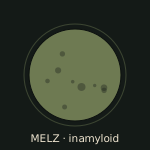 MELZ | inamyloid | Spore wall does not turn blue-black, but the ornamentation is thrown into sharp relief and the smooth plage becomes obvious. | 3.00 |
 KOH5 | negative | Cap cuticle darkens to a dull brown; no chrome yellow, no red. | 2.00 |
 FESO4 | negative | Flesh and cuticle unchanged after 60 s. | 3.00 |
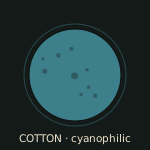 COTTON | cyanophilic | The warty ornamentation stains blue and the plage stays clear, so the spore reads as an ornamented oval with a bare notch. | 2.00 |
Injury stain The stem base browns progressively from handling and from drying, and the mycelial felt turns from white to buff. There is no blueing and no reddening. The brown staining is not diagnostic — it is a decay process shared with the harmless look-alike.
Block 03 · Confusion
| Separating character | This record | Confused with |
|---|---|---|
| A firm, persistent ring that survives on mature fruit bodies, a stem that is clearly scaly below the ring, dense caespitose tufts on hardwood stumps, and a two-toned cap with a cinnamon centre against a pale margin. | Galerina marginataT3 | Kuehneromyces mutabilis▲ +3 |
| A far smaller lawn species with a cap under 25 mm and smooth spores with a germ pore; equally T3, and equally not separable by any character other than the spore ornamentation. | Galerina marginataT3 | Conocybe filaris▲ +0 |
| Grows on soil, not on wood; a white shaggy cylindrical cap; gills that deliquesce to black ink within hours rather than a rusty spore deposit. | Galerina marginataT3 | Coprinus comatus▲ +3 |
Toxicity ladder
A single meal of a normal-sized fruit body has killed, or the toxin class (amatoxins, orellanine, gyromitrin, severe muscarine load) is documented as lethal in humans. T3 does not mean every meal kills — it means the margin between a meal and a fatal dose is not wide enough to plan around, and there is no field test that measures it.
Lamella · https://honeydew.top