KingdomFungiGenusAmanitaSpeciesphalloides
Amanita phalloides
T3 · LethalPublished 2026-08-11Late summer / Autumn
Death cap poisoning is not a rare accident caused by reckless foraging. It is a reproducible clinical event with a documented dose-response, a fixed latency and a treatment window that closes before the patient feels unwell. The species is included here because identification, not ingestion, is the only reliable control point, and because the pale form of the cap is genuinely difficult to separate from three harmless species.
Block 01 · Record
Field characters and where they fail
The olive-green cap is the field character people rely on, and it is the least stable one: the pale form is almost white, and old specimens fade to a dirty cream. Two characters are stable. The first is the volva, a soft white sac sheathing a bulbous base — it is usually buried, so you must excavate with a trowel rather than pull. The second is the free gill attachment with a persistent skirt-like ring. Neither character requires colour vision, and neither is affected by weathering.
The toxin and why the latency matters
Amatoxins are bicyclic octapeptides that survive cooking, freezing and drying without measurable loss. Alpha-amanitin inhibits RNA polymerase II, so cells that transcribe heavily — intestinal epithelium and hepatocytes — die first. The clinical sequence is bifurcated and that is what makes the poisoning lethal: a gastrointestinal phase at 6-24 hours that resolves on its own, then a silent interval of 24-72 hours, then hepatic failure. People present at hospital in the silent interval feeling recovered, and the amatoxin dose cannot be measured in the field by any test on this bench.
Habitat, season and the introduced range
Fruiting follows the host trees rather than the climate. In Europe the species appears from late July to November under oak and sweet chestnut, with a second flush after the first hard rain of October. Where it has been introduced with its hosts — parts of California, the Pacific Northwest, Australia and New Zealand — the fruiting window shifts with local rainfall and can extend into December. Fruit bodies are often half-buried in litter and appear in loose troops rather than singly.
Discrimination against the two field look-alikes
Amanita citrina has a marginate bulb: the top of the bulb forms a sharp, shelf-like rim around the stem, which A. phalloides never does. Cut a piece and put it in a closed container for thirty seconds; A. citrina smells of raw potato, A. phalloides has no distinctive odour. Amanita vaginata has no ring at all and a cap margin striate over a third of the radius. When only dried fragments remain, the discriminator is microscopic: Amanita trama lacks clamp connections, Cortinarius trama has them.
Points to carry to the bench
- Excavate the whole stem base — the volval sac is the most stable character and it is usually buried.
- Free gills plus a persistent skirt-like ring plus a sac at the base; all three, not any two.
- No field test on this bench measures amatoxin. There is no taste test, no colour test and no smell test that clears a specimen.
- Amanita trama lacks clamp connections; a rusty spore print in an overnight deposit excludes the genus.
| Cap | shape: Convex to plano-convex, 50-150 mm across, sometimes flat in extreme age; margin smooth and entire.surface: Olive-green, yellowish-green or, in the common pale form, almost white; silky with faint radial fibrils, viscid when wet.margin: Smooth, without striations, sometimes retaining a few white patches of the universal veil. |
|---|---|
| Gills | attachment: Free — there is a clear gap of 2-4 mm between the gill backs and the stem apex on a longitudinal section.spacing: Crowded, 1.5-2.5 gills per millimetre at the margin; short intermediate gills are abundant and irregular in length.edge: White, entire, minutely floccose under a hand lens; the edge never darkens with age. |
| Spore print | Broadly ellipsoid to subglobose, thin-walled, with a small but distinct hilar appendix.Smooth, inamyloid, often with a single large refractive oil drop filling most of the spore. |
| Habitat and season | Ectomycorrhizal with oak, sweet chestnut, hornbeam and, in introduced stands, with beech and hazel; strongly associated with mature trees rather than with saplings. Fruit bodies appear on soil among leaf litter, often half-buried, frequently in loose troops along the edge of a wood or under a hedge line. |
Block 02 · Chemistry
| Reagent | Verdict | Reaction | Weight |
|---|---|---|---|
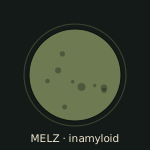 MELZ | inamyloid | Spores stay pale; a faint grey wash on some spores is not a blue-black amyloid reaction and should not be read as one. | 3.00 |
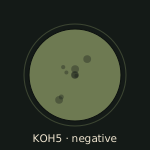 KOH5 | negative | Cap cuticle lightens to yellow-brown or, on the pale form, stays almost unchanged; no chrome yellow flash. | 2.00 |
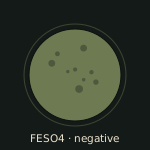 FESO4 | negative | Flesh shows no reaction within 60 s; occasional faint grey-green over the cuticle is within range. | 3.00 |
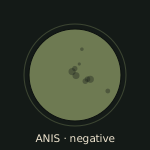 ANIS | negative | No change on the cap cuticle or on fresh flesh; the drop stays the colour of the reagent itself. | 2.00 |
 COTTON | acyanophilic | Spores remain unstained; the thin wall shows a clear, evenly thick outline against the blue background. | 2.00 |
Injury stain None to very slight yellowing in the stem flesh after prolonged exposure to air. Crucially, no blueing and no reddening at any bruise — the flesh of a cut specimen stays white for hours. A green-capped agaric that blues where cut is not this species and does not belong to the same tier.
Block 03 · Confusion
| Separating character | This record | Confused with |
|---|---|---|
| A distinctly marginate bulb — a sharp-edged rim where the cap-like top of the bulb meets the stem — plus a raw-potato odour that becomes unmistakable after 30 s in a closed container. | Amanita phalloidesT3 | Amanita citrina▲ +2 |
| No ring at any stage, deeply striate cap margin over a third of the radius, and a volva that remains a loosely fitting white sheath rather than a torn collar. | Amanita phalloidesT3 | Amanita vaginata▲ +3 |
| Dried base fragments are the real problem: Amanita lacks clamp connections in the trama, Cortinarius has them. Spore print settles it in a night — white versus rusty brown. | Amanita phalloidesT3 | Cortinarius rubellus▲ +0 |
Toxicity ladder
A single meal of a normal-sized fruit body has killed, or the toxin class (amatoxins, orellanine, gyromitrin, severe muscarine load) is documented as lethal in humans. T3 does not mean every meal kills — it means the margin between a meal and a fatal dose is not wide enough to plan around, and there is no field test that measures it.
Lamella · https://honeydew.top