KingdomFungiGenusCortinariusSpeciesrubellus
Cortinarius rubellus
T3 · LethalPublished 2026-10-13Late summer / Autumn
This is the species that most of the European orellanine poisonings are actually attributed to, because it is far more abundant than Cortinarius orellanus and grows in exactly the habitats where people walk in late summer: acid spruce and pine woods, sphagnum hollows and bilberry heath. Like its better-known relative, it produces no early symptoms at all.
Block 01 · Record
The shape and the alkali reaction
Cortinarius rubellus has a sharper, more tapering umbo than C. orellanus and a thinner, more fibrillose cap surface; the overall silhouette is conical rather than merely convex. On the bench, potassium hydroxide turns the cap cuticle deep blood-red to vinaceous within thirty seconds and the colour then fades to brown over the following minute. That red flash is one of the most striking alkali reactions in the genus, but it is not diagnostic on its own: several harmless Cortinarius species do the same, and the reaction must never be used to clear a specimen.
Spores and the cortina girdle
The spore deposit is rusty brown to cinnamon-orange and needs a night on white paper. Spores are 8-10 x 5.5-6.5 micrometres, ellipsoid to narrowly amygdaliform, verrucose, and inamyloid but strongly outlined in Melzer's reagent. The cortina is orange-yellow and conspicuous on young fruit bodies; on mature ones it survives as a fibrillose girdle on the upper stem and as fibres adhering to the cap margin. That orange girdle is the most useful field trace of the genus when the fruit body is otherwise unremarkable.
Habitat, and why the exposure is high
The species is ectomycorrhizal on strongly acid, often peaty or waterlogged soils with spruce, pine and birch, and its typical sites are exactly where late-summer and autumn walkers go: sphagnum hollows, bilberry heath, the mossy edges of bog pools and the banks of upland tracks. Fruit bodies are often partly buried in moss and are easily overlooked, and they are frequently found in loose groups rather than singly. In upland Britain and Scandinavia the exposure to this species is substantially higher than to C. orellanus.
The orellanine course, again
Orellanine is a bipyridyl N-dioxide that accumulates in the proximal tubule and inhibits protein synthesis there; the symptom-free interval runs from three days to three weeks, and the first thing the patient notices is usually thirst and polyuria — not a gastrointestinal upset. By the time renal function is falling the toxin has already done its work, and there is no antidote. Published series from Poland and Finland show long-term dialysis or transplant in a substantial fraction of severe cases. Cooking, drying and freezing do not reduce the orellanine content, and there is no field test for it anywhere on this bench.
Points to carry to the bench
- Potassium hydroxide turns the cap blood-red in 30 s, then fades to brown — a genus character, not a clearance test.
- Spores 8-10 micrometres, verrucose, rusty brown in deposit; cortina orange-yellow and conspicuous when young.
- Grows with spruce, pine and birch on acid peat and sphagnum; the commonest orellanine source in upland Europe.
- Three days to three weeks of no symptoms, then thirst, polyuria and falling renal function; no antidote.
| Cap | shape: Conical to campanulate with a sharp, tapering umbo, becoming convex to plane while keeping the umbo, 30-80 mm across; the margin is thin and long-inrolled.surface: Dry, finely tomentose to silky-fibrillose, orange-brown to rusty-brown, paler and yellower at the margin and darker at the umbo.margin: Thin, entire, without striations; the orange-yellow cortina attaches here on young specimens. |
|---|---|
| Gills | attachment: Adnate to narrowly adnexed; the attachment becomes hard to judge on mature specimens because the cap is convex and the gills are partly hidden.spacing: Subdistant to close, 25-40 gills reaching the margin on a 60 mm cap, with one or two series of intermediates.edge: Entire and concolorous, orange-ochre when young and rusty-orange at maturity. |
| Spore print | Ellipsoid to narrowly amygdaliform, with a roughened wall and a small hilar appendix.Verrucose, with warts that are finer than those of C. orellanus but still clearly visible at 400x. |
| Habitat and season | Ectomycorrhizal on strongly acid, often peaty or waterlogged soils with spruce, pine and birch; typical sites are sphagnum hollows, bilberry heath, the edges of bog pools and the mossy banks of upland tracks. |
Block 02 · Chemistry
| Reagent | Verdict | Reaction | Weight |
|---|---|---|---|
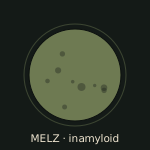 MELZ | inamyloid | No blue-black reaction; the warts outline sharply and are easier to count than in a water mount. | 3.00 |
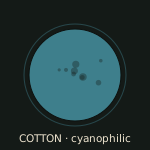 COTTON | cyanophilic | Warts stain blue against a paler wall. | 2.00 |
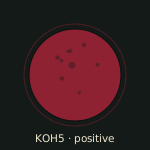 KOH5 | positive | Cap cuticle turns a deep blood-red to vinaceous within 30 s, then fades to brown — a reaction several Cortinarius share and which is not diagnostic on its own. | 2.00 |
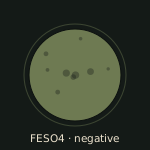 FESO4 | negative | Flesh unchanged after 60 s. | 3.00 |
Injury stain None in the flesh, but the alkali reaction on the cuticle is striking: potassium hydroxide turns the cap surface blood-red within half a minute. That red flash is a Cortinarius character, not a safety character, and it is shared by harmless members of the genus.
Block 03 · Confusion
| Separating character | This record | Confused with |
|---|---|---|
| Both species carry orellanine and both are T3; the separation is academic. C. orellanus has a blunter, broader umbo, distinctly distant gills and a yellower cortina. | Cortinarius rubellusT3 | Cortinarius orellanus▲ +0 |
| A smaller, more slender species with the same alkali-red cap reaction; it is treated as carrying the same hazard because the orellanine content of the small Cortinarius species has never been systematically surveyed. | Cortinarius rubellusT3 | Cortinarius gentilis▲ +0 |
| Blunt forked folds rather than true gills, a hollow grey-yellow stem, no cortina at any stage, and a cream spore deposit rather than rusty brown. | Cortinarius rubellusT3 | Craterellus tubaeformis▲ +3 |
Toxicity ladder
A single meal of a normal-sized fruit body has killed, or the toxin class (amatoxins, orellanine, gyromitrin, severe muscarine load) is documented as lethal in humans. T3 does not mean every meal kills — it means the margin between a meal and a fatal dose is not wide enough to plan around, and there is no field test that measures it.
Lamella · https://honeydew.top