KingdomFungiGenusCortinariusSpeciesorellanus
Cortinarius orellanus
T3 · LethalPublished 2026-09-28Late summer / Autumn
The fool's webcap is not a mushroom that kills quickly. It is a mushroom that produces no symptoms for three days to three weeks, by which time the kidneys have already begun to fail, and for which there is no antidote. The latency is the hazard, and it is the reason this species is the reference example of a T3 record with a completely unremarkable field appearance.
Block 01 · Record
An unremarkable appearance
Cortinarius orellanus looks like a dozen other webcaps. The cap is 30-80 mm, orange-brown to rusty-brown, dry and finely felted, with a low obtuse umbo; the gills are adnate and unusually widely spaced for the genus; the stem is cylindrical and often buried in sand; and the yellow cortina is gone before the cap is half expanded. The one useful field feature is the gill spacing — 15-25 gills reach the margin on a 60 mm cap, which is markedly distant compared with most of its congeners — but gill spacing is a judgement, not a test.
Spores and the coarse warts
The spore deposit is rusty brown and needs a night on white paper. Spores are 8.5-11.5 x 5.5-7 micrometres, ellipsoid to slightly amygdaliform, with a strongly verrucose wall; the coarse warts are visible at 400x and are among the most conspicuous ornamentation of any species in this collection. The spores are inamyloid, but in Melzer's reagent the warts outline sharply and the ornamentation becomes far easier to characterise than in a water mount. Cotton blue stains the warts blue against a paler wall.
Orellanine and the delayed renal syndrome
Orellanine is a bipyridyl N-dioxide that accumulates in the proximal tubule and inhibits protein synthesis there. The clinical sequence is unlike any other mushroom poisoning: a symptom-free interval of 3 to 20 days, then thirst, polyuria, nausea and back pain as renal function falls, then acute renal failure. Because there is no early gastrointestinal phase, the meal is almost never suspected. There is no antidote, and roughly half of the severe cases in the published series have required long-term dialysis or transplant.
Habitat, season and the identification discipline
The species is ectomycorrhizal with oak and beech on acidic sandy or gravelly soils, and it fruits from late August to October, most often on slopes and wood banks where the soil is bare. Because the fruit body is both common and unremarkable, the practical discipline is structural rather than visual: treat every rusty-spored agaric with a cortina and widely spaced thick gills as unidentified until it has produced a spore print, and reject any collection in which a member has not been individually checked. Cortinarius armillatus is the pair to know in the field — its brick-red girdle bands on the stem are the easiest Cortinarius character there is, and it is also organ-toxic.
Points to carry to the bench
- Latency of 3-20 days with no early gastrointestinal phase — the meal is almost never suspected.
- Coarse verrucose spores 8.5-11.5 micrometres; warts visible at 400x.
- Widely spaced thick adnate gills, 15-25 reaching the margin on a 60 mm cap.
- No antidote; orellanine accumulates in the proximal tubule and causes acute renal failure.
| Cap | shape: Convex to plane with a low obtuse umbo, 30-80 mm across, occasionally reaching 100 mm; the margin is thin, at first inrolled then straight.surface: Dry, finely tomentose to appressed-fibrillose, giving a felted look; orange-brown to rusty-brown, darker at the centre and paler at the margin.margin: Thin and entire, without striations even when wet; the cortina is attached here in young specimens. |
|---|---|
| Gills | attachment: Adnate to narrowly adnexed, meeting the stem by most of their depth or with a small notch.spacing: Distant to subdistant — the widest gill spacing of any Cortinarius in this collection, with 15-25 gills reaching the margin on a 60 mm cap.edge: Thick and entire, yellow-ochre when young and turning rusty-orange as the spores mature. |
| Spore print | Ellipsoid to slightly amygdaliform, with a roughened wall and a small hilar appendix.Strongly verrucose — the coarse warts are visible at 400x and are among the most conspicuous of any spore in this collection. |
| Habitat and season | Ectomycorrhizal on acidic, sandy or gravelly soils under oak and beech, most often on slopes, wood banks and along the sandy shoulders of forest tracks; fruit bodies frequently emerge through bare soil or thin moss rather than through leaf litter. |
Block 02 · Chemistry
| Reagent | Verdict | Reaction | Weight |
|---|---|---|---|
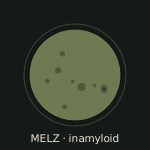 MELZ | inamyloid | The spore wall does not turn blue-black, but the coarse warts are strongly outlined and the ornamentation is far easier to count than in water. | 3.00 |
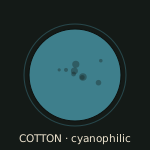 COTTON | cyanophilic | Warts stain blue against a paler wall, giving a strongly patterned outline. | 2.00 |
 KOH5 | negative | Cap cuticle darkens to a deeper red-brown without turning yellow or green. | 2.00 |
 FESO4 | negative | Flesh unchanged after 60 s; a faint grey wash on the cortina zone is within range. | 3.00 |
Injury stain None. Cut flesh stays pale yellow-cream for hours and does not blue, redden or blacken. In a genus where several species blue strongly with alkali or oxidise to red, the absence of any reaction is itself a character — but it is a character shared with every other harmless-looking Cortinarius, so it carries no safety information.
Block 03 · Confusion
| Separating character | This record | Confused with |
|---|---|---|
| Brick-red to vermilion girdle bands of fibrils on the stem, a larger and fleshier fruit body, and growth with birch rather than oak; it is also a T2 species, so the pair carries risk in both directions. | Cortinarius orellanusT3 | Cortinarius armillatus▲ +1 |
| A cinnamon-brown cap with yellow flesh, crowded olive-yellow gills and a much smaller stature; separated from C. orellanus by the crowded gills and the birch habitat. | Cortinarius orellanusT3 | Cortinarius cinnamomeus▲ +2 |
| Blunt forked folds rather than true gills, apricot-yellow colour throughout, apricot odour, and a spore print that is cream rather than rusty brown. | Cortinarius orellanusT3 | Cantharellus cibarius▲ +3 |
Toxicity ladder
A single meal of a normal-sized fruit body has killed, or the toxin class (amatoxins, orellanine, gyromitrin, severe muscarine load) is documented as lethal in humans. T3 does not mean every meal kills — it means the margin between a meal and a fatal dose is not wide enough to plan around, and there is no field test that measures it.
Lamella · https://honeydew.top