KingdomFungiGenusChlorophyllumSpeciesmolybdites
Chlorophyllum molybdites
T1 · Gastrointestinal irritantPublished 2026-08-28Summer / Autumn
This is the most common cause of serious mushroom poisoning in North America, and it is a lawn species that fruits in the same rings and the same weeks as the parasol mushroom people collect on purpose. Every character except the spore print overlaps. The result is a poisoning syndrome that is rarely fatal and consistently miserable.
Block 01 · Record
Why the spore print is not optional
The cap scales, the stalk proportions, the ring and the free gills of Chlorophyllum molybdites are all within the range of Macrolepiota procera as most people read it. Two characters are reliable. The ring of C. molybdites is thick and persistent and does not slide up and down the stem, whereas a parasol ring over the lower half of its range does. And the spore print is dull green to grey-green, which no other large temperate agaric produces. Because the print takes a night, the safe protocol is to photograph and spore-print every parasol-shaped lawn agaric you intend to keep, and to discard anything whose print has not been read.
Spores and the pseudoamyloid reaction
Spores are 9-13 x 6-9 micrometres, ellipsoid, thick-walled, with a small truncate germ pore. In Melzer's reagent the wall turns a deep reddish-brown to rusty within two minutes. At low magnification this looks like an amyloid reaction and has caused the species to be placed in the wrong genus more than once; at 1000x the colour is clearly dextrinoid rather than blue-black. Record the magnification every time you record the result.
Turf, rings and irrigation
The species is a saprotroph of managed turf and it follows irrigation rather than rainfall. Lawns, parks, golf fairways, sports fields and irrigated verges are the standard sites; it is much rarer in unimproved pasture. It is faithful to a site and frequently returns in the same ring for a decade or more, expanding slowly outward. In warm temperate and subtropical regions the season runs from June to November with a peak in late summer; in cooler regions it appears only in the hottest weeks of August and September.
The syndrome and its limits
The toxins are proteins that are destroyed by heat, which is why the species produces a violent but typically self-limiting gastrointestinal syndrome rather than organ damage: vomiting within thirty minutes to three hours, profuse watery diarrhoea, cramping and dehydration. Children and older adults with cardiac or renal conditions are the people who end up in hospital on fluids. The tier is T1 because there is no documented hepatic or renal injury — but T1 describes the syndrome, not the severity of the night, and this is the species most often responsible for a family being admitted to the same emergency department on the same evening.
Points to carry to the bench
- Dull green spore print — the only large temperate agaric that produces one, and the only decisive character.
- Ring is thick, persistent and does not slide; a sliding ring points to Macrolepiota procera.
- Flesh does not redden when cut, which excludes Chlorophyllum rhacodes within a minute.
- Fruits in irrigated turf in rings; T1 describes a self-limiting syndrome, not a mild one.
| Cap | shape: Ovoid then campanulate, finally plane, 80-200 mm across and occasionally 300 mm; the disc usually remains slightly raised.surface: Cream to white ground covered in concentric, recurved scales that are brown to greyish-brown at the disc and become smaller and sparser toward the margin.margin: Thin at maturity, often irregularly split, and frequently bearing ragged white veil remnants in young specimens. |
|---|---|
| Gills | attachment: Free, with a distinct 3-8 mm gap between the gill backs and the stem apex.spacing: Crowded, 2-3 gills per millimetre; the gills are broad, up to 15 mm deep, and their colour change with age is the most conspicuous feature of the species.edge: White and entire when young; the whole gill surface passes from white through cream to greyish-green as the spores mature, often with a mottled intermediate stage. |
| Spore print | Ellipsoid to broadly ellipsoid, thick-walled, with a small truncate germ pore at one end.Smooth; the wall reacts strongly in Melzer's reagent, and the reaction is the reason the species was once placed with the amyloid-spored groups. |
| Habitat and season | Saprotrophic in managed turf: lawns, parks, golf fairways, sports fields, roadside verges and garden beds, on soil enriched by irrigation and fertiliser. Extremely faithful to site and often returning in the same ring for many years. |
Block 02 · Chemistry
| Reagent | Verdict | Reaction | Weight |
|---|---|---|---|
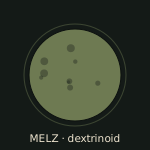 MELZ | dextrinoid | Spore wall turns a deep reddish-brown to rusty within 2 minutes — a strong pseudoamyloid reaction that looks amyloid at low magnification and must be read at 1000x. | 3.00 |
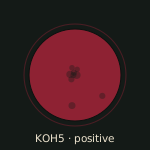 KOH5 | positive | Cap scales turn orange-brown; the pale ground between them stays unchanged, producing a strongly mottled result. | 2.00 |
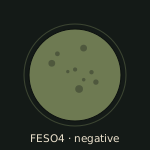 FESO4 | negative | Flesh shows no reaction within 60 s or a very faint grey-olive wash. | 3.00 |
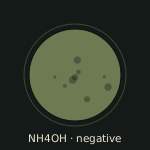 NH4OH | negative | Cap surface darkens slightly; no yellow, green or purple development. | 2.00 |
Injury stain None to a faint browning at the stem base after long exposure. The flesh stays white to cream and does not redden — which is what separates it from Chlorophyllum rhacodes within a minute of cutting.
Block 03 · Confusion
| Separating character | This record | Confused with |
|---|---|---|
| Snakeskin fibril pattern on the stem, a ring that slides freely, and white to cream spores; M. procera never produces a green deposit at any age. | Chlorophyllum molybditesT1 | Macrolepiota procera▲ +1 |
| Cap and stem flesh redden to saffron within 30-60 s of cutting, and the scales are larger and plate-like rather than contiguous and recurved. | Chlorophyllum molybditesT1 | Chlorophyllum rhacodes▲ +1 |
| A strongly rimmed bulb at the stem base, distinct dark brown scales that are not concentric, and the same green spore deposit. | Chlorophyllum molybditesT1 | Chlorophyllum brunneum▲ +1 |
Toxicity ladder
Reproducible vomiting, cramping and diarrhoea with no hepatic, renal or neurological involvement. Onset is short and recovery is complete, but the same species can produce a severe dehydrating episode in children and in people on diuretics or beta blockers.
Lamella · https://honeydew.top