KingdomFungiGenusMacrolepiotaSpeciesprocera
Macrolepiota procera
T0 · No known toxinsPublished 2026-09-03Summer / Autumn
The parasol is the species that trips up collectors who trust size. Its stature, its snakeskin stem and its movable double ring are all good characters, but only one of them is decisive against the two Chlorophyllum species that fruit in the same grassland at the same time. That character is the spore print, and it takes a night.
Block 01 · Record
The snakeskin stem and the ring that slides
Two characters separate M. procera from its congeners in the field. The stem below the ring carries a serpentine pattern of brown fibrils over a pale ground — a snakeskin, not a uniform brown — and this pattern persists on dried specimens. The ring is thick, double-edged and, over the lower half of the stem, slides freely up and down. Neither character is diagnostic on its own, but a specimen with both is very unlikely to be anything else.
Spore print, spores and the dextrinoid test
The spore print is white to pale cream and needs a full night. A thick deposit is chalky and glossy. Spores are 14-18 x 9-12 micrometres, ellipsoid, thick-walled and smooth in the light microscope; they carry a broad truncate germ pore that flattens one end. In Melzer's reagent the spore wall and inner wall layers turn reddish-brown to rusty within two minutes — a clean dextrinoid reaction, which is unusual enough among white-spored agarics that it is worth recording every time. Cotton blue stains the thick wall and leaves the germ pore as a clear window.
Where it grows and when
This is a soil saprotroph, not a mycorrhizal partner, and it responds to land management rather than to trees. Grazed pasture, mown verges, woodland rides and hedge banks are the standard habitats, and the species is most abundant in the first two seasons after grazing or mowing opens up the sward. Fruit bodies are solitary to scattered, occasionally forming loose rings. The season runs from July to late October, with a sharp peak in September; a single large specimen can appear a full week before any others in the same field.
Discrimination: the two Chlorophyllum species
Chlorophyllum molybdites has a dull green spore print, a stem without the snakeskin pattern, and a ring that does not slide. Its cap squamules are also more uniform in size and often have a greenish cast. Chlorophyllum rhacodes reddens to saffron within a minute of cutting, most visibly at the stem base. If you have cut a parasol and the flesh is still white after two minutes, you have excluded C. rhacodes; only the overnight spore print excludes C. molybdites.
Points to carry to the bench
- Snakeskin fibril pattern on the stem below the ring, and a ring that slides freely.
- Dextrinoid spores — reddish-brown in Melzer's within two minutes.
- No reddening or yellowing at the cut surface after two minutes.
- Only an overnight spore print separates it from Chlorophyllum molybdites; a green print is disqualifying.
| Cap | shape: Ovoid then campanulate to umbonate, finally flat with the margin uplifted, 100-250 mm across; the umbo remains raised throughout.surface: A cream felt ground breaking into concentric rings of brown to grey-brown squamules that radiate from a solid dark umbo and become sparser and smaller toward the margin.margin: Initially appendiculate with white veil fragments, then torn and recurved; not striate. |
|---|---|
| Gills | attachment: Free, with a collar of tissue around the stem apex; the gap between the gill backs and the stem is 3-6 mm on a longitudinal section.spacing: Crowded, 2-3 gills per millimetre at the margin, with short intermediate gills in between.edge: White, minutely floccose under a hand lens, often showing a faint reddish-brown line where the gill edge has dried. |
| Spore print | Ellipsoid, thick-walled, with a broad truncate germ pore that flattens one end of the spore outline.Smooth, dextrinoid; the wall is about 1 micrometre thick away from the germ pore. |
| Habitat and season | Saprotrophic in grazed pasture, woodland rides, verges and hedge banks, on soil rather than on wood; most frequent in the first two seasons after pasture is opened up by mowing or grazing. Solitary to scattered, occasionally in loose rings. |
Block 02 · Chemistry
| Reagent | Verdict | Reaction | Weight |
|---|---|---|---|
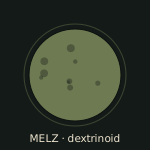 MELZ | dextrinoid | Spore wall and the inner wall layers turn reddish-brown to rusty within 2 minutes — the classic dextrinoid reading. | 3.00 |
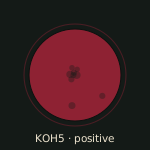 KOH5 | positive | Cap squamules turn orange-brown to greenish-brown; the pale ground tissue between them shows no reaction. | 2.00 |
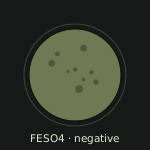 FESO4 | negative | Flesh unchanged after 60 s; a slow grey-green wash occasionally appears on the stem context. | 3.00 |
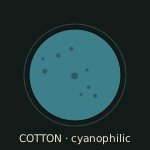 COTTON | cyanophilic | The thick spore wall stains blue, leaving the germ pore as a clear unstained patch at one end. | 2.00 |
Injury stain None. Cut flesh stays white to cream for hours. The absence of any reddening, yellowing or browning at the cut is what separates this species from the two Chlorophyllum look-alikes, both of which discolour within a minute.
Block 03 · Confusion
| Separating character | This record | Confused with |
|---|---|---|
| The stem lacks the snakeskin pattern and the ring does not slide; the spore print is dull green and is the only reliable confirmation, which is why no parasol should be collected without one. | Macrolepiota proceraT0 | Chlorophyllum molybdites▲ +1 |
| Flesh reddens to saffron within 30-60 s of cutting, especially at the stem base, and the cap squamules are larger and more plate-like. | Macrolepiota proceraT0 | Chlorophyllum rhacodes▲ +1 |
| Slenderer, with a pronounced central umbo that is smooth and pale rather than dark, and a smaller stature overall; equally T0. | Macrolepiota proceraT0 | Macrolepiota mastoidea▲ +0 |
Toxicity ladder
No toxin has been isolated or reproduced in feeding trials, and decades of documented ingestion carry no reproducible syndrome. T0 is a statement about the chemistry of the species, never a statement about a specimen in your hand.
Lamella · https://honeydew.top