KingdomFungiGenusLepiotaSpeciesbrunneoincarnata
Lepiota brunneoincarnata
T3 · LethalPublished 2026-10-01Summer / Autumn
The deadliest mushrooms are not the largest ones. This species is 2 to 4 centimetres across, grows in the gravel at the edge of a garden path, and contains amatoxins at concentrations that have killed both adults and children. It is the reason the small brown-scaled white-spored agarics of gardens and lawns belong in a separate category from the parasols they superficially resemble.
Block 01 · Record
Why size is the trap
The cap is 15-40 mm across, cream with concentric rings of brown to brownish-red felty squamules and a solidly dark umbo. The gills are free and crowded white, the ring is a thin membrane that often collapses, and there is no volva. Every one of those characters is a smaller version of something harmless, which is exactly how the mistake happens: a troop of these growing near a group of young Macrolepiota reads as a single species at different stages of growth. Check every specimen, not the troop.
Spores and the dextrinoid reaction
The spore print is pure white. Spores are 6.5-9 x 3.5-5 micrometres, ellipsoid to oblong, thick-walled, with a small germ pore, and they are dextrinoid — the wall turns reddish-brown in Melzer's reagent within two minutes, uniformly and legibly at 400x. Cotton blue stains the wall and leaves the germ pore as a clear window. The dextrinoid reaction is the fastest bench confirmation that a small white-spored lawn agaric has a thick-walled, germ-pored spore rather than the thin-walled inamyloid spore of a Marasmius.
Garden substrates and the season
Lepiota brunneoincarnata is a saprotroph of enriched soil and it follows human management rather than natural vegetation: flower beds, plant pots, greenhouses, mulched borders, gravel margins and the gaps between paving slabs. It reappears at the same site for several years. In temperate Europe the season runs from July to November, with the peak in September and October; in greenhouses it can fruit outside that window entirely, which removes the seasonal cue that collectors otherwise rely on.
The amatoxin syndrome in a small dose
The amatoxin content of this species is comparable per gram to Amanita phalloides, and the mass of a single fruit body is enough: published paediatric cases have involved a handful of caps. The clinical sequence is the standard amatoxin course — a gastrointestinal phase at 6-24 hours that appears to resolve, a silent interval, and hepatic failure at 3-5 days — and the small size of the fruit bodies means caregivers rarely connect the illness to a mushroom found in the flower bed days earlier. There is no field test that measures amatoxin, and none of the characters above will tell you the dose.
Points to carry to the bench
- A 15-40 mm cream cap with concentric brown felty squamules and a dark umbo, on free crowded white gills.
- Dextrinoid spores 6.5-9 micrometres with a germ pore, pure white deposit.
- Grows in garden beds, gravel margins and greenhouses from July to November.
- Amatoxin content comparable to Amanita phalloides per gram — a few caps is a lethal dose for a child.
| Cap | shape: Convex to plano-convex with a low umbo, 15-40 mm across, rarely larger; the margin is incurved and often carries veil remnants.surface: A pale cream ground broken into concentric rings of brown to brownish-red, felty squamules that become sparser toward the margin and leave the umbo solidly dark.margin: Incurved, with fine white veil fragments adhering in most specimens. |
|---|---|
| Gills | attachment: Free, with a 1-2 mm gap at the stem apex.spacing: Crowded, 3-4 gills per millimetre on a cap of only 25 mm; the crowding is conspicuous at this size.edge: White and entire; the gills stay white at every age and never darken. |
| Spore print | Ellipsoid to oblong, thick-walled, with a small but distinct germ pore at one end.Smooth and dextrinoid; no ornamentation at any magnification used at this bench. |
| Habitat and season | Saprotrophic in gardens, flower beds, lawns, path edges, greenhouses and plant pots; often on soil that has been enriched or mulched. Frequently emerges through gravel or between paving slabs, and reappears at the same spot for several years. |
Block 02 · Chemistry
| Reagent | Verdict | Reaction | Weight |
|---|---|---|---|
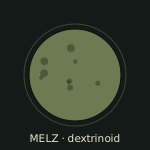 MELZ | dextrinoid | Spore wall turns reddish-brown within 2 minutes; the reaction is uniform and easy to read at 400x. | 3.00 |
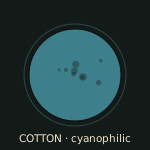 COTTON | cyanophilic | The thick wall stains blue and the germ pore remains a clear unstained window. | 2.00 |
 KOH5 | negative | Cap squamules darken slightly to a deeper brown; no yellow or green development. | 2.00 |
 FESO4 | negative | Flesh unchanged after 60 s. | 3.00 |
 ANIS | positive | Grey-violet on the cap cuticle within two minutes, deepening towards black over the disc at thirty minutes. | 2.00 |
Injury stain None. The white flesh stays white after cutting and after prolonged exposure, and the ring and gills do not discolour with handling. There is no bruise reaction of any kind — which, in a genus this small, is not a reassurance.
Block 03 · Confusion
| Separating character | This record | Confused with |
|---|---|---|
| At 100-250 mm across, the parasol is five to ten times the linear size; it also has a snakeskin stem and a sliding ring. Size alone separates them, but only if the collector notices that the small fruit bodies are a separate species rather than young parasols. | Lepiota brunneoincarnataT3 | Macrolepiota procera▲ +3 |
| A disagreeable, rubbery or coal-gas odour, a pronounced white collar of veil on the stem, and more distinctly separated scales; it is T1 rather than T3 but is not worth the discrimination effort for a two-centimetre mushroom. | Lepiota brunneoincarnataT3 | Lepiota cristata▲ +2 |
| A tough pliant stem, widely spaced thick waxy gills, and growth in rings in short turf; the gill spacing alone excludes the crowded white gills of the Lepiota. | Lepiota brunneoincarnataT3 | Marasmius oreades▲ +3 |
Toxicity ladder
A single meal of a normal-sized fruit body has killed, or the toxin class (amatoxins, orellanine, gyromitrin, severe muscarine load) is documented as lethal in humans. T3 does not mean every meal kills — it means the margin between a meal and a fatal dose is not wide enough to plan around, and there is no field test that measures it.
Lamella · https://honeydew.top