KingdomFungiGenusPleurocybellaSpeciesporrigens
Pleurocybella porrigens
T2 · Organ toxicPublished 2026-10-25Autumn
Angel wings were eaten for decades in Japan, where they are known as sugihiratake and were regarded as an ordinary autumn mushroom. In 2004 they caused a cluster of acute encephalopathy in which 59 people were affected and 17 died, and almost every severe case shared one thing: the patient was undergoing haemodialysis. It is the clearest example in this collection of a hazard that depends on the host rather than on the dose.
Block 01 · Record
A mushroom indistinguishable from an oyster at a glance
The cap is pure white, thin, fan- to spoon-shaped and 20-60 mm across, growing in dense overlapping shelves on conifer wood. The gills are narrow, crowded and connected by frequent cross-veins; there is no stem or only a rudimentary one. Pleurotus ostreatus, the oyster mushroom, has a grey to grey-brown cap, firm flesh, gills without cross-veins, and grows predominantly on hardwood. Colour and texture separate them at sight, and the cross-veins confirm it under a hand lens — but neither character is a chemical test, and both rely on the collector being willing to look.
Spores and the reagent bench
The spore print is white and thin and is best taken on black card. Spores are 5-7 x 4-5 micrometres, globose to subglobose, smooth, thin-walled, inamyloid, with no germ pore and no oil drop — structurally the least distinctive spore in this collection. On the bench the species gives negative results to Melzer's reagent, potassium hydroxide and iron(II) sulfate, and a positive guaiac reaction within sixty seconds, consistent with a white-rot wood decayer. None of these results distinguishes it from the oysters.
Old conifer forest and the autumn flush
The species is a saprotroph of conifer wood and it is a marker of old, humid, undisturbed forest: it fruits on fallen branches, logs and stumps of spruce and fir, on the underside and sides of the wood, in dense overlapping shelves. It is most abundant in montane and boreal forests with a long history of continuous cover. The season is a single autumn flush running from September to November, and fruit bodies are cold-tolerant, continuing to appear after the first frosts when most other agarics have stopped.
What happened in 2004
Between August and October 2004, 59 people across nine prefectures of Japan developed acute encephalopathy after eating sugihiratake, and 17 died. The pattern was unusual in three ways: virtually all of the severe cases were patients on haemodialysis for chronic renal failure, the syndrome was neurological rather than gastrointestinal, and it appeared as seizures and disturbance of consciousness rather than as anything resembling a standard mushroom poisoning. Subsequent work identified an unstable aziridine amino acid, pleurocybellaziridine, and a lectin-like protein, and the current understanding is that a metabolite that is normally cleared by the kidney accumulated in patients whose kidneys were no longer clearing anything. The tier is T2: the injury is real and documented, the toxin has been partly characterised, and the risk is concentrated in a specific and identifiable host group.
Points to carry to the bench
- Pure white, thin, fan-shaped caps in overlapping shelves on conifer wood; gills with cross-veins.
- Pleurotus ostreatus is grey-brown with firm flesh and no cross-veins, and grows mostly on hardwood.
- All bench reactions negative except guaiac — no chemical test separates it from an oyster.
- 2004 Japanese outbreak: 59 affected, 17 died, almost all on haemodialysis. Host-dependent hazard.
| Cap | shape: Fan- to spoon-shaped, 20-60 mm across, attached laterally or on a short rudimentary stem; the margin is thin, inrolled when young and lobed or wavy at maturity.surface: Pure white to ivory, smooth, matte and slightly translucent so that the gills show through the thin cap in back-light.margin: Thin, entire when young, becoming lobed and irregularly wavy; the margin is translucent and curls upward on old specimens. |
|---|---|
| Gills | attachment: Decurrent along the rudimentary stem and radiating from the attachment point on specimens without one.spacing: Narrow and crowded, 4-6 gills per millimetre, with frequent cross-veins connecting adjacent gills — the cross-veins are the character that separates it from Pleurotus.edge: Entire and thin; the gills stay white at every age and never yellow or grey. |
| Spore print | Globose to subglobose, smooth, thin-walled, with a small hilar appendix.Smooth and inamyloid; no germ pore and no oil drop, and the spores are unremarkable in every respect. |
| Habitat and season | Saprotrophic on the dead wood of conifers, above all on fallen branches, logs and stumps of spruce and fir in old, humid, undisturbed forest; fruit bodies grow in dense overlapping shelves on the underside and sides of the wood. |
Block 02 · Chemistry
| Reagent | Verdict | Reaction | Weight |
|---|---|---|---|
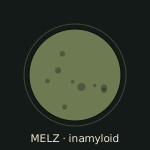 MELZ | inamyloid | Spore wall stays pale; no blue-black development. | 3.00 |
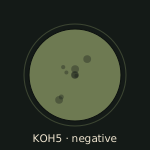 KOH5 | negative | Cap and gills show no reaction whatever; the white pigment is stable to alkali. | 2.00 |
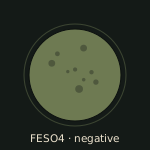 FESO4 | negative | Flesh unchanged after 60 s. | 3.00 |
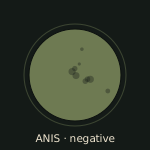 ANIS | negative | No change on the white cap or on the translucent flesh. | 2.00 |
 GUAIAC | positive | Fresh context turns blue within 60 s, consistent with a white-rot wood decayer. | 1.00 |
Injury stain None. The white flesh keeps its colour when cut or bruised and does not yellow, brown or blacken. There is no reaction of any kind, which is exactly the difficulty: nothing about the mushroom's appearance or behaviour signals that it is anything other than an oyster mushroom.
Block 03 · Confusion
| Separating character | This record | Confused with |
|---|---|---|
| A grey to grey-brown or slate cap, a firm and slightly tough flesh, gills without cross-veins, and growth predominantly on hardwood; the pure white colour and the crowded cross-veined gills of P. porrigens separate it on sight. | Pleurocybella porrigensT2 | Pleurotus ostreatus▲ +2 |
| A pale grey-white oyster with a firmer, thicker cap and gills that run down a short but distinct stem; it grows on both hardwood and conifer wood, which is where the pairing becomes genuinely dangerous. | Pleurocybella porrigensT2 | Pleurotus pulmonarius▲ +2 |
| A larger, firmer, grey-white species with a distinct veil on the cap margin and a tough flesh; equally separable on colour and texture rather than on any chemical test. | Pleurocybella porrigensT2 | Pleurotus dryinus▲ +0 |
Toxicity ladder
The toxin reaches an organ and damages it. Latency is the defining hazard: Cortinarius orellanus and Amanita smithiana produce no symptoms for 3 to 20 days, by which time renal function is already falling. T2 also covers syndromes that require a co-factor, such as coprine and ethanol, or a susceptible host, such as Pleurocybella porrigens in dialysis patients.
Lamella · https://honeydew.top